
Does college cause students to lose their faith?

I have been reading and enjoying Sam Rainer’s blog for the last month or so.  Sam is co-author of Essential Church?, which I have blogged about previously (here and here).

In his latest blog entry, Rainer discusses the impact of secular colleges on the faith of Christian students.  There seems to be a common belief that students who attend these types of colleges are at greater risk of losing their faith than those who do not.  Here is what Rainer had to say about this:

Our research has debunked the myth that the influence of the secular university pushes young adults out of the church. No significant difference exists between the dropout rates of those who attend at least a year of college and those who do not. For those that attend college, 69% of active churchgoing youth stop attending church for at least a year between the ages of 18 and 22. Yet 71% of active youth who do not go to college stop attending church during the same period.

So overall, the college itself is not to blame for the dropout issue. What about analyzing different majors? New research from the University of Michigan reveals some surprising results on religiosity and the college major. They measure religiosity by religious attendance and how important students consider the importance of religion in their lives. Here are some highlights from the study:

  • The odds of going to college increase for high school students who attend religious services more frequently or who view religion as more important in their lives.
  • Being a humanities or a social science major has a statistically significant negative effect on religiosity.
  • Students in education and business show an increase in religiosity over their time at college.
  • Majoring in the biological or physical sciences does not affect religious attendance of students.

Are you surprised by this finding?  I have to admit that I am a little.  Does this change your feelings about attending a secular university or sending your children to one?
Posted in Church Issues | Tagged , , , , , , , , , , , , , , | 13 Comments

Should churches evaluate pastors and ministries?

Businesses do it annually.  Some may even do it more often.  But is it appropriate for a church to evaluate its current ministries and staff? After all, the church is not a business.  What would the evaluation criteria be?  Members?  Attendance?  Money?  None of these seem biblical.  If a church was primarily interested in these things it could just become a social club and have more success.

Perhaps the evaluation could be done based upon how happy the members are?  This does not seem quite right either.  A church is designed to help its people grow in Christian maturity.  This growth could happen during times of pain and unhappiness.  If churches were most interested in keeping their people happy, it would be easier to let them remain as they are without challenging them to grow.  It would probably even be beneficial for churches to praise their people for where they are.  Everyone likes to be praised.

Perhaps we could evaluate based upon how much people are “growing”?  This one seems tricky.  How do we know someone is growing?  What if the ministries are good, but the people are just hard-hearted?  The Old Testament prophets came across this situation.  They proclaimed God’s word exactly how he wanted, but the people often did not listen.  Can we blame the ministries and pastors if the people are not responding?

So, should a church evaluate?  If so, how?  What criteria would you use to evaluate the ministries of the church?  What criteria would you use to evaluate the pastor (or pastors)?

Posted in Church Issues | Tagged , , , , , , , , , , , | 10 Comments

Why we do the things we do – VBS Edition

VBS (Vacation Bible School) is in full force at my church.  It has been a busy week.  I was thinking to myself Monday as I was finishing up some final preparation: “Why do we do this?”  I mean, if you have ever been involved in VBS, you are probably aware of how tiring and time-consuming it really is.  I was exhausted last night – and it was only Wednesday!  I still have today and tomorrow to go.

But I do know why we do it.  I am reminded every time I see the kids smiling, laughing, and enjoying time with each other and their leaders.  For whatever reason, the kids love VBS.  For me, that is all I need to know.

Posted in Church Issues | Tagged , , , , , , , , , , , | 4 Comments

Are You Too Ashamed to Ask?

I have been blogging about church issues lately, especially in relation to why people leave the church between the ages of 16 to 22 and how we can stop the trend.

During one of the previous discussions on this site, a commenter mentioned that she is hesitant to invite people she knows to her church because of problems that her church is currently dealing with.  This comment reminded me of something I read in a book called Building a Contagious Church a few years ago.  The book, which is about doing outreach effectively, tells readers that we can invite people to church all we want, but if they come and we do not have ministries in place that answer the questions they are asking and meeting the needs they have, they will not stay long.

I wonder how many churches are struggling for just this reason.  How many churches are ineffective at outreach simply because their members are not sure that the church has relevant ministries in place?  Would you agree that this is a real issue in churches?  Has it ever stopped you from inviting a person to your church?

Posted in Church Issues | Tagged , , , , , , , , , | 3 Comments

How Old is Too Old for Motherhood?

Maria del Carmen Bousada has died.  She was 69.  In her death, Bousada has left behind twin boys who are not yet three years old.  Young twins?  Yes.  Bousada became a mother at age 66 through in vitro fertilization.  You can read an article about her death here.

This situation should cause us all to stop and think about the legal and ethical issues involved.

First, there are the legal questions.  Should there be an age limit on who is eligible for procedures such as in vitro fertilization?  There currently is no law in the U.S. that would prohibit a woman of any age from undergoing this procedure.  The clinic in L.A. that performed the process on Bousada has a cutoff age of 55, but Bousada simply lied about her age to get around it.  If we establish a legal cutoff age, would it not be age discrimination?

Secondly, there are the ethical concerns.  Should a woman have a child at such an advanced age?  The likelihood of her death is very high, so the probability of her caring for the children long-term is extremely low.  Should a person who knows they are unlikely to be able to offer long-term care seek to have children?  If not, how does this apply to younger would-be moms who are battling illnesses such as cancer, but are considering having a child?

As we consider the issue, we must not only think of the rights of the mother, but also the rights and welfare of the child(ren).  Should laws, or our ethical reasoning, be influenced by doing what is best for the children involved, or should we only focus on the mother?

What are your thoughts?

Posted in Human Rights | Tagged , , , , , , , , , , , , , , | 9 Comments

Did Constantine Invent a New Jesus?

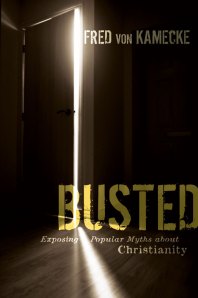
Busted von KameckeBooks like The Da Vinci Code by author Dan Brown have made it popular to believe that our current understanding of Jesus is wrong.  In fact, some would even say that our current understanding of who Jesus is comes as a result of a single man, Constantine, in the fourth century.  It is argued that Constantine put together a selection committee to determine what books circulating around at the time should be considered Scripture and be a part of our Bibles.  In the process, it is argued, Jesus was transformed from the merely human king of the Jews into deity.  Of course, all of this was to serve Constantine’s political aspirations.

Thankfully, Bible scholars have answered The Da Vinci Code’s version of history with a little reality.  There are many books available today written at a popular level so readers can look into this matter for themselves.

Fred von Kamecke, while not writing specifically to answer the claims of Dan Brown’s novel, has written a book that does address this issue (and others).  In his book, Busted: Exposing Popular Myths about Christianity, von Kamecke sets out to “bust” popular myths about Christianity in the style of the popular cable show Mythbusters.  The book is a great entry-level work that gives a fair overview of the issues it addresses.  It is written in an engaging, easy-to-read way with a good amount of humor mixed in.  I would recommend it to anyone wanting to know what some of the popular myths about Christianity are and how to think clearly about them.  If you are a blog reader, I am sure you have run across a few already!

When von Kamecke addresses this myth about Constantine re-writing the Christian Scriptures, he points out several things to keep in mind:

  1. All of the New Testament documents were written in the first century and widely circulated by the fourth.  Even skeptical scholars affirm this as true.
  2. To pull off a re-write of Christianity, Constantine would have had to gather all of the other versions already circulating and replace them with his version.
  3. Unfortunately, Constantine would not have been able to accomplish this because hundreds of Greek manuscripts (as well as Latin, Syriac, Coptic, and Ethiopic versions) were being used by the Church throughout the Roman Empire.
  4. Many of these early manuscripts were already buried in the Egyptian sands where they would not be discovered until the 1800s.
  5. We have many manuscripts today dating from the second and third centuries that disprove any “changes” that Constantine’s group supposedly made.  There are no New Testament manuscripts that tell us of a simply human Jesus in opposition to the divine Jesus of Constantine.
  6. All New Testament manuscripts present the same Jesus.  He is always Christ, the Lord who is the divine Son of God and who died for our sins and rose again.
  7. The early church fathers, writing before Constantine, quoted the New Testament so extensively that even if all of the New Testament manuscripts would disappear, we could virtually reconstruct the New Testament from their writings.
  8. The writings that present a different Jesus than found in the New Testament are from a later time period and originate in foreign areas with no Jewish root. 
  9. There never has been 100 percent agreement on which books to include in the canon.  This shows that there never has been an authority powerful enough to make the Christian world accept its canon.
  10. The 66 books of the Protestant canon are accepted by all Christian groups as Scripture – there is no dispute on these.  (This last point is my own, not the author’s.)

Want to hear more about Busted: Exposing Popular Myths about Christianity?  There are several other blogs discussing this book today.  You can find them at the links below.  Also, on Thursday, July 16, Ann Jackson will be giving away copies of Busted on her blog at http://flowerdust.net .

http://bbhchurchconnection.blogspot.com

http://icrucified.com/icruciblog

http://twelve60.blogspot.com

http://blog.buildingchurchleaders.com

http://frankviola.wordpress.com

http://johnharmstrong.com

http://jchrisland.blogspot.com

http://www.biblegeekgonewild.com

http://www.kimmartinezstayingfocused.wordpress.com/

Posted in Book Reviews, Church History | Tagged , , , , , , , , , , , , , | 8 Comments

How do you know when your church is struggling?

Sam Rainer, co-author of Essential Church?, has written an article for OutreachIn the article, Rainer discusses signs that point to a struggling local church.  Here is what he writes:

Over 90% of churches are declining or growing less than the community around them. The national trends are not good. Before church leaders surrender to frustration and church members yield to apathy, our composite research shows there are signs along the way that suggest a church is becoming unhealthy. The following list is not exhaustive, but let’s see some key signals that an individual congregation is beginning to struggle.

We don’t emphasize Bible study anymore. When God’s Word is not the driving force of a church, people are bound to travel down the wrong road. Churches that do not elevate the proclamation and study of God’s Word veer off course. A lack of deep biblical teaching is one of the most glaring signs of a struggling church.

We cut our outreach budget. When we consult with churches and examine their budgets, a key health indicator is how much the church allocates to outwardly focused ministries. Struggling churches give less toward their mission each year—less money, less prayer and fewer people.

Our church doesn’t change with the community. Struggling churches are led by leaders with little to no understanding of their immediate context. As a result, their congregations either do not know about changes in the community’s demographics or they refuse to change with them. Every church leader must minister with the following question at the forefront: “What are the biggest needs in my community?

We don’t take risks. Unfortunately, many church leaders have been beat up or burned. As a result, they focus more on not getting in trouble with their congregation than turning the world upside down for Jesus. They lead churches to play it safe rather than taking risks to reach more people.

We don’t have a clear discipleship plan. A struggling church does not have an answer to the new believer or member who asks, “Now what?” These churches may have an abundance of programs and ministries, but they do not have an intentional plan to help believers become more like Christ. The absence of a discipleship plan leaves the back door wide open.

Would you agree with these signs?  Is there anything else you would add?

I would add (and mentioned these on Rainer’s blog) that struggling churches become more interested in protecting their traditions than finding new ways to reach out to their neighbors.  And struggling churches see the unsaved in their community as the enemy rather than reaching out to them in love.

Posted in Church Issues | Tagged , , , , , , , , , , , , | 11 Comments

When Does Personal Experience Trump God’s Word?

Recently, I went to hear a Christian leader talk about his conversion from Islam to Christianity.  It seems that one of the chief influences in his life was his girlfriend at the time, who was a Christian.

The Christian girlfriend (now the man’s wife) spoke of the internal conflict she felt while the two were dating.  She told us that she knew that it was wrong for a Christian to date and/or marry an unbeliever based upon 2 Corinthians 6:14-18.  However, she did not want to end the relationship.  She told us that she prayed to ask God what she should do and that she “felt an overwhelming peace”, which she understood as God’s approval of the relationship.

Since the woman felt that God had given his approval, she continued on in the relationship.  The two were later married and still later, the man came to be a Christian.  Everything worked out, which all involved saw as further confirmation that God had approved of the relationship all along.

Here is my question:  When does our subjective experience outweigh the clear word of God?  In this case, should the woman have understood that God had approved of her relationship even though 2 Corinthians 6 tells us that believers and unbelievers do not belong together?

Is it possible that the woman desired God’s approval so much that she convinced herself that he had given it?  Just because things worked out in the end, does this signify God’s approval of the entire process?  Could God have worked even in the midst of disobedience?

What are your thoughts?

Posted in Bible | Tagged , , , , , , , , , , , | 10 Comments

For the Philosophers…

Check out the video below.  I found it on the Don’t Stop Believing blog of Mike Wittmer.  If you enjoy philosophy, you will enjoy this.

Posted in Uncategorized | Tagged , , , , , , , , , , , , , | 2 Comments

Do Patriotic Songs Belong in Church Worship Services?

us-flagThe 4th of July holiday is quickly approaching.  For many of us, that means picnics, fireworks and looking forward to singing some great patriotic songs in church on Sunday morning.

Does your church do this?  If so, you may also repeat the process on Memorial Day weekend.  Have you ever thought that it was out of place, or even wrong?  I have.

Please do not get me wrong.  I love my country.  I would never desire to live anywhere else in the world and I am thankful for all of those who have served in our military through the years to keep us safe and free.  However, when I go to church, I go to worship my God for who he is, what he has done, what he is doing, or what he is going to do.  Most patriotic songs are not focused on the greatness of God, they are focused on the greatness of the United States.

Do you think I am wrong?  Here are some of the words from America the Beautiful:

“O beautiful for spacious skies, for amber waves of grain, for purple mountain majesties above the fruited plain!  America! America! God shed His grace on thee, and crown thy good with brotherhood from sea to shining sea.”

It is true that the song mentions God (although it is not necessarily the Christian God – any religion could use this same song and feel comfortable), but where is the focus of the song?  It is on the greatness of America.  Proper focus in a church worship service should be on the greatness of God; the one who shed his grace on America.  We can thank God for the United States and for shedding his grace on our great land, but he should be the focus.

Another example is My Country, “Tis of Thee:

“My country, ’tis of thee, sweet land of liberty, of thee I sing: Land where my father’s died, land of the pilgrim’s pride, from every mountain side let freedom ring.  My native country, thee, land of the noble free – thy name I love: I love thy rocks and rills, thy woods and templed hills; my heart with rapture thrills like that above.”

Again, where is the focus of this song?  It is certainly not on God.  Am I wrong or is the gathering of the saints supposed to be for corporate worship of our God?  Are we replacing worship of God with worship of country?  I know this will not be a popular post with many, but if you disagree with me, please tell me why I am off-track.  I know we live in a great country.  It is a country blessed by God and it is God we should gather to honor on 4th of July weekend and every other Sunday of the year.  We do this by making him (and him alone) the focus of all we do – including the songs we sing.

Before you accuse me of being “anti-” or “un-” American, please understand that I do not have a problem with patriotic songs.  In fact, I think there is a time and place to pay honor to our country and these songs are great for that.  However, I do not believe the time or place is in a church worship service where the focus should be God.

Okay, now you can blast me with your comments.

Posted in Church Issues | Tagged , , , , , , , , , , , , | 24 Comments