
Why Torture is Always Wrong

With the recent release of the “Torture Memos” there has been an enormous amount of discussion centered on the treatment of wartime prisoners.  If you have missed the discussion, just turn on Fox News or CNN.  You will soon find yourself immersed in the topic.

Those who support using torture or “enhanced interrogation techniques” to get information from captives argue that the ends justify the means.  In other words, if we are able to gain important information about our enemies through these techniques, then the techniques are okay.  To defend the use of the “enhanced interrogation techniques”, supporters are calling for the release of classified information (in addition to the Torture Memos previously released) to show that the techniques were successful in extracting vital military intelligence.  The thought is that if it can be proven that important information was gained through the process then the process cannot be criticized.

How should we think about torture (or whatever you choose to call it)?  Is it ever okay?  If torture does result in giving us greater military intelligence, can it be justified?

I came across an important article by Christopher Tollefsen that discusses this very topic.  I believe Tollefsen is exactly right in his assessment of the issue.  In his article, Tollefsen attempts to give a precise definition of torture and condemns the practice as always wrong.  Here is a quote from the article:

It is important to be clear, as a moral matter, on what boundaries should be accepted in interrogation of human beings. These sorts of boundaries, regardless of whether they are called torture, or “cruel, inhuman and degrading” treatment, are the ones that matter for our most basic assessment of how agents of the United States Government should comport themselves when questioning terror suspects. The discussion should not, that is to say, begin with questions about how the nature of the terrorists’ crimes, or their status as illegal enemy combatants, affects what may be done. For, if there are forms of treatment forbidden as such for all human beings, then such forms of treatment will be ruled out for terror suspects just as for prisoners of war, and common criminals.

Please read the entire article and let me know what your thoughts are concerning this important issue.  If you missed the link above you can find the complete article here.
Posted in Human Rights, War, Worldview | Tagged , , , , , , , , , | 14 Comments

Out for a week…

Just to let all of you know, I will be out of town and away from my computer for a week on vacation.  I will not be able to moderate any comments while I am gone and I also will not be posting anything new until Monday, April 27 (at the earliest).

I did post a new book review on The Apologetics Study BibleThank you for reading.  I will post again when I return.

Tim

Posted in Uncategorized | Tagged , , , , , | 1 Comment

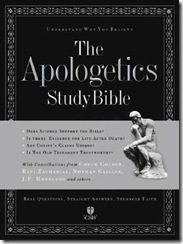
Review: The Apologetics Study Bible

ApologeticsStudyBible Have you ever had a discussion with someone about the Bible who did not understand how you could believe the things you believe?  Have you ever wished that you had one source that you could turn to that would help you defend your faith to skeptics?  The Apologetics Study Bible may be exactly what you are looking for.

Unlike other study Bibles that include notes that are primarily concerned with explaining the meaning of the text, The Apologetics Study Bible’s notes are primarily concerned with explaining the difficult texts that critics like to turn to (i.e. some of the Old Testament laws, etc.) and giving insight when there is historical / archaeological evidence to support a passage.

Perhaps of greatest value to the reader are the over 120 articles included in this Bible that pertain to current Christian apologetics.  These articles are written by leading biblical scholars including: Chuck Colson, Norm Geisler, Hank Hanegraaff, Josh McDowell, Albert Mohler, Ravi Zacharias, J. P. Moreland, William Lane Craig, Gary Habermas, Darrell Bock, Paul Copan, and Phil Johnson.  Some of the topics that these articles cover are: the accuracy of our Bibles, miracles, Jesus’ resurrection, evidence for life after death, and how the Bible relates to other religions.  I found these articles, written by experts in each area, to be excellent overviews of  the topics that they discuss.  These articles should give the reader a solid foundation upon which to build.

The Apologetics Study Bible also includes book introductions for each book of the Bible and profiles of some of the leading Christian apologists in history, including Anselm of Canterbury, Thomas Aquinas, Augustine of Hippo, and C. S. Lewis.

If you want a Bible that will help you discuss your faith with skeptics or if you are interested in learning more about how scholars defend Christianity, I would recommend this study Bible to you.

The Apologetics Study Bible from Holman Bible Publishers is available in the Holman Christian Standard Bible translation.

Posted in Book Reviews | Tagged , , , , , , , , | 2 Comments

A. N. Wilson: Christian turned Atheist turned Christian

Writer A. N. Wilson has published an article in the New Statesman explaining why he has turned from atheism to Christianity.  Wilson, who was an atheist for 20 years discusses why he left Christianity to begin with and what led him back to his faith.  Here is a small quote that I found interesting:

But religion, once the glow of conversion had worn off, was not a matter of argument alone. It involves the whole person. Therefore I was drawn, over and over again, to the disconcerting recognition that so very many of the people I had most admired and loved, either in life or in books, had been believers. Reading Louis Fischer’s Life of Mahatma Gandhi, and following it up with Gandhi’s own autobiography, The Story of My Experiments With Truth, I found it impossible not to realise that all life, all being, derives from God, as Gandhi gave his life to demonstrate. Of course, there are arguments that might make you doubt the love of God. But a life like Gandhi’s, which was focused on God so deeply, reminded me of all the human qualities that have to be denied if you embrace the bleak, muddled creed of a materialist atheist. It is a bit like trying to assert that music is an aberration, and that although Bach and Beethoven are very impressive, one is better off without a musical sense. Attractive and amusing as David Hume was, did he confront the complexities of human existence as deeply as his contemporary Samuel Johnson, and did I really find him as interesting?

Take the time to read the whole article.  It is definitely worth it.

Posted in Atheism, Worldview | Tagged , , , , , , , , , | Comments Off on A. N. Wilson: Christian turned Atheist turned Christian

What Song Do You Want Played At Your Funeral?

Music plays an important role in our lives.  It also plays an important role in our deaths.  Often a song is able to express through music and lyric what none of us can with our own words.

Most funeral songs are picked to either express the thoughts of the living concerning the deceased or because the song was a favorite of the deceased.  Perhaps a certain song captures the spirit of the departed.

I am sure that every generation has its most popular picks for funerals as new songs are written and people’s music tastes change.  However, some of the more popular funeral choices made today may surprise you.  According to Co-operative Funeralcare, some of the most popular songs played at funeral services in England are:

  • “My Way” by Frank Sinatra (how autonomous of us)
  • “Highway to Hell” by AC/DC (imagine the looks on some people’s faces as this one is played)
  • “Another One Bites the Dust” by Queen (I assume this is an attempt to bring humor to the moment)

Of course, there are more traditional songs that are popular as well.  What do you think?  Are the picks above good ones?  What would you like played at your funeral?

Posted in Culture | Tagged , , , , , , , , , , | 6 Comments

Why Do We Ignore Gluttony?

It seems that we, as Christians, tend to zero in on the sins of our culture pretty quickly.  We like to criticize homosexuality, alcoholism, gambling, etc.  Well, how come we ignore one of our culture’s “biggest” issues: gluttony?  The Bible tells us it is wrong.  Check out Deuteronomy 21:20; Proverbs 23:20-21; and Titus 1:12 if you would like some examples of how the Bible speaks of this sin.

The worst thing about our gluttony is that we do not think of it as wrong.  Some of us do not think about it at all.  We over-consume on almost a daily basis.  Sadly, we are even passing along our unhealthy and sinful ways to our children.  Apparently, 1 in 5 four year old children are obese.  1 in 5!

What are your thoughts?  Why do we seem to ignore this problem?  I suspect it is because so many of us are guilty of it.

Posted in Bible, Culture | Tagged , , , , , , , , | 6 Comments

Some are willing to pay for “de-baptism”

Imagine if you were baptized as an infant, but then decided you wanted nothing to do with Christianity as you became older.  Or, perhaps you became so angry at some of the things the Church was saying and/or doing that you wanted to make some type of statement.  What would you do?

Well, in England many are willing to pay for certificates of “de-baptism.”  In fact, over 1500 people have paid $4.35 for certificates from the National Secular Society.

I admit that I am not Catholic and I belong to a Protestant tradition that does not practice infant baptism (we only baptize those who choose to be baptized).  But here are my thoughts about “de-baptism”:

  1. It is unnecessary theologically.  If one wants to deny their baptism, there is no church tradition that I am aware of that will say “Too bad. You are still a Christian.”  People walk away from the Church and Christianity at every age.  Baptism does not prevent this from happening.
  2. Save your money!  Since you can legitimately walk away for free, why pay to have a certificate?  It sounds like the National Secular Society has just found an easy way to make a little money to me.
  3. There is no officially published list of those who have been baptized.  Why be on an official “de-baptized” list?  What do you gain by it?
  4. If your motivation is political, rather than theological, you may want to think twice.  I understand that a person can legitimately become angry with the Church (in this case the Church of England).  However, your baptism is bigger than any single church or denomination.  It signifies a believer’s relationship with God.  If you wish to be “de-baptized” just to show you are upset with a particular church group, you should find another way to do it.  Are you ending your relationship with the Church or with God?

What are your thoughts?  Would you pay to be de-baptized?

Posted in Church Issues, Culture | Tagged , , , , , , , , , , | 2 Comments

Teenage Vegetarianism: Is It An Eating Disorder?

An article at Time cites a study that claims that teenage vegetarianism may be a sign of an eating disorder.  It turns out many teens use a vegetarian diet, which is socially acceptable and usually supported by parents, to mask an eating disorder and avoid certain foods.

The study suggests that adolescents who are vegetarians are far more likely than other teens to use dieting or extreme and unhealthy weight-loss measures to control weight.  Also, teens who have an eating disorder are more likely to practice vegetarianism than those from other age groups.

You can read the  entire article here.

Of course, not every teenager who is a vegetarian has an eating disorder.  Some have legitimate and good reasons for their diet that should be supported.  However, we need to understand our children and the pressures they face so we can see warning signs when they appear.

Posted in Culture | Tagged , , , , , , , , , , , | 4 Comments

Is Gay Marriage a Game to You?

Today, Vermont became the fourth state to legalize gay marriage joining Connecticut, Massachusetts, and Iowa.  The decision came down to a 100-49 vote in the House, which was the minimum vote required to overturn a veto issued by Vermont governor Jim Douglas.

One of the more interesting comments that I have read concerning the decision in Vermont came from Democratic Representative Jeff Young.  Young, who previously voted in opposition to gay marriage, decided to change his vote and support the veto override.  Here is what Young said concerning his decision to change his vote:

“You realize that, you know, it’s a poker game in some ways,” Young said. “Chips on the table. I’m a freshman. I have no chips. If I … had 20 years of chips, I probably could play any card I want. I don’t have that option.”

He added, “It’s the way the political game is played.”

Rep. Young says he remains philosophically opposed to gay marriage, but decided that voting along with the Democratic party line would help his career in the future.

My information concerning Rep. Jeff Young is taken from an Associated Press article found here.

Regardless of where one stands on the gay marriage issue, Jeff Young’s words should cause concern.  Is the issue of gay marriage simply a game?  Are we electing representatives who act in ways simply to advance their careers?  It seems to me that on an issue that is so important to so many people, we expect our leaders to act based upon their convictions of what is right.  Young admits that he thinks gay marriage is wrong, but he voted to support it because it was best for his career as a politician.  Is this alarming to anyone else?

Posted in Gay Marriage | Tagged , , , , , , , , , | 24 Comments

Review: Holman QuickSource Guide to Understanding Jesus, Jeremy Howard

understanding-jesus-coverWith this post begins a new feature to this site: book reviews!  It is my goal to review newly-released books that deal with Christian theology, worldview, apologetics, and Bible study.  These resources will help those of you who are interested dig deeper into many of the topics that are discussed on this site.


With Easter only a few days away, what greater topic is there to discuss than the life, death and resurrection of Jesus?  Easter Sunday marks the most important event in history for those who are Christians.  However, many on the outside of Christianity, and even many within, are not really sure of the significance of the day.  Why did Jesus die?  Why does it matter if he rose from the dead?  And how does Jesus fit into the entire story of the Bible?

These are all good and important questions.  They are also the types of questions that author Jeremy Howard sets out to answer in the Holman QuickSource Guide to Understanding Jesus.  In his book, Howard begins at the beginning – the garden of Eden.  In a highly readable and engaging format, the author tells the over-arching story of Scripture.  This is not just a focus on the life of Christ, but a presentation of how Jesus fits into the big picture.  So many Christians and non-Christians really do not have a grounded understanding of the sweeping narrative of the Bible.  This books does much to correct that.

The narrative style and the clear writing of the author are the clear strengths of this wonderful book.  Howard is able to incorporate many of the most important, and sometimes difficult, themes of both the Old and New Testaments in a way that both the average reader and the more advanced student can glean much from.  The 400 page book is also a very attractive presentation, having a large number (200+) of color images interwoven within the text.

Overall, I highly recommend this book to anyone who wants to better understand the big picture of the Christian worldview and how Jesus fits into the picture.  This is probably the best non-technical treatment of the topic I have read.

There are also five other books in the Holman QuickSource series (Bible Atlas, Christian Apologetics, Understanding the Bible, Bible Dictionary, and Understanding Creation).  I have not read the others, but if they are on par with Understanding Jesus, they would be worth the effort.

Let me know if you have read, and what your thoughts are concerning, Understanding Jesus or any of the other titles in this series.

Posted in Book Reviews, Jesus | Tagged , , , , , , , , , , , , , | 7 Comments