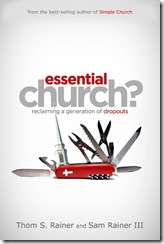
Would you leave your church because of the music?

I am still reading through Essential Church?, which I have posted on previously.  In the book, the authors say that despite the attention that worship style gets, people do not tend to leave (or stay) based on music.  If the authors are correct, many of our churches are focused on the wrong thing and wasting a great deal of their time arguing over something that is not going to help or hurt them in the end.

What do you think?  Are the authors right?  Would you leave your church if the style of music was not what you desired?  How does worship style influence your decision to stay or go?

Posted in Church Issues | Tagged , , , , , , , , , , , , , | 12 Comments

Interracial Marriage and the Bible

interracial marriageI came across a study of racial preferences of online daters recently that had some interesting statistics.  The chart to the left comes from the study and highlights the frequency of interracial marriages for different ethnic groups.  It is obvious from the chart that, while there are interracial couples, people have a strong tendency to marry others of their own ethnicity.

How should we think about interracial dating / marriage?  Should we be opposed?  Should we encourage it?  For Christians, our answers come from the Bible, so the first place we should look for guidance is there.

At first glance, one may be inclined to believe that the Bible is opposed to interracial marriage.  Deuteronomy 7:3 and Ezra 10:11 are examples of verses found in the Old Testament that warn Israel against intermarriage.  However, when we look closer we will find that this is simply not true.  The passages in the Old Testament are concerned with those who would marry outside of the faith, not those who would marry someone from a different ethnic background.

How do we know this?  Because we have examples in the Old Testament where interracial marriages are recognized by God as a good thing.  Joseph married Asenath, an African (Genesis 41:50), from whose relationship came the tribes of Manasseh and Ephraim.  Moses also married an African woman and was criticized by Aaron and Miriam for doing so (Numbers 12:1).  God punished Aaron and Miriam for their criticism of Moses (Numbers 12:4-9).  And Matthew mentions two non-Israelites in the genealogy of Jesus in Matthew 1:5.  Rahab was a Canaanite and Ruth was a Moabite.

The New Testament also sheds some light on this issue.  The New Testament counterpart to the Old Testament law concerning intermarriage is found in 1 Corinthians 7:39 and 2 Corinthians 6:14-18.  Neither of these passages has anything to do with race or ethnicity, but only say that a believer should not marry an unbeliever.

How should Christians feel about interracial marriage?  We should recognize that all people, regardless of race or ethnicity, are created in the image of God and have equal value.  There is nothing wrong with interracial marriage.  The only marriages we should oppose are those between a Christian and a non-Christian, whether they are of the same ethnicity or not.

Posted in Marriage / Dating | Tagged , , , , , , , , , , , , , , , | 2 Comments

PETA Cares About Flies Too…

PETA wishes Barack Obama had not killed a fly during a recent interview.  Apparently, PETA supports “compassion even for the most curious, smallest and least sympathetic animals” and they “believe that people, where they can be compassionate, should be, for all animals,” according to PETA spokesman Bruce Friedrich.

In response to the slaying, PETA is sending President Obama a humane bug catcher, which will allow him to catch house flies and release them outside without harm.  How thoughtful of them.

Does anyone else think this is ridiculous?  I agree we should care for the environment and animals, but why do we allow an extreme group like PETA to have a voice?  They should not be the primary group that influences our laws and thinking about animal treatment.  I wonder how they feel about me swatting the mosquito sucking the blood out of my arm.  Should I just allow it to finish and fly away?

What are your thoughts about Obama killing flies and PETA?  Do you own (or want) a Katcha Bug humane bug catcher?

In case you missed the Obama interview, here it is:

Posted in PETA | Tagged , , , , , , , , , , , , , | 6 Comments

What Should I Read?

I am a reader.  At minimum, I read a book every two weeks.  I love to learn and grow through the expertise and experience of others.

However, it is often hard to know what books to look for when I am visiting the local bookstores.  Nothing is more disappointing (well some things are) than bringing home a new book, diving in and finding out you wasted your money.

I would love to know if you have any books that you feel are “must reads”.  Most of my time is spent reading theology or other books on religion, but I am willing to crack open a great novel now and then, or a great biography or historical book.  What do you recommend?  Give me two books in the comments and tell me why you think I (and others) should read them.

Posted in Book Reviews | Tagged , , , , , , , , , , , , | 9 Comments

Follow the Leader…Right Into “Meltdown”

california-state-flagI have lived in California for nearly three years now and I have confirmed in my time here that Californians take pride in their state.  Why are they proud?  Because California sets the pace of our nation – at least that’s what Californians believe.  We are on the cutting edge in almost every area of technology, environmental concern, social concern, etc., etc.

Well, California is showing that it does not have all of the answers.  In fact, it may be showing the rest of the country that it would be better off finding its “leader” elsewhere.  The state’s budget is in such a mess that the state could run out of money in 50 days.  How is that possible?  California already taxes its people at a higher rate than almost every other state in the country.  Is it possible that some of those cutting edge programs that we like to take pride in are really beyond our means (even if they are good ideas)?

The state budget deficit in California is at such an extreme condition that the state is actually considering eliminating the welfare system.  Of course, there is also a discussion about raising the taxes of an already over-taxed population.  How will this thing end?  For those Californians reading, are you concerned?

Posted in Politics | Tagged , , , , , , , , , , | Comments Off on Follow the Leader…Right Into “Meltdown”

Are Americans Exploring New Ways of Experiencing God?

How do you experience God?  According to the Barna Group, Americans’ attitudes towards this area of their lives are changing.  In a poll of over 1000 people, here is what the data shows that people think about their faith:

88% of American adults say that “my religious faith is very important in my life.”

Faith is not going away despite the prolific media attention devoted to the demise of traditional faith practices and beliefs. Nine out of ten adults admit that their faith plays a meaningful role in their life. There is nothing on the horizon to suggest that this is likely to change in the foreseeable future.

75% say they sense that “God is motivating people to stay connected with Him, but in different ways and through different types of experiences than in the past.”

There is a growing sense of release from traditional religious practices in this country. People are suggesting that they want more of God and less of the stuff that gets between them and their relationship with God. This mindset is equally common among Catholics and Protestants.

45% say they are “willing to try a new church.”

A staggering number of Americans – almost half of the nation’s 230 million adults – are open to changing their church home, demonstrating their lack of connection with their present community of faith and their desire to have a more significant connection. It may also be a reflection of people’s increasing lack of loyalty to both organizations and personal relationships, and the growing sense that there is always something better available if you can simply find it.

64% say they are “completely open to carrying out and pursuing your faith in an environment or structure that differs from that of a typical church.” 

Two out of three adults contend that they are not tied to a conventional church setting as they seek to experience and express their faith. This openness to new contexts, processes and structures is especially common among Baby Boomers (68%). Interest in pursuing faith is similar in all areas of the nation with the exception of the Northeast (56%).

50% say “a growing number of people I know are tired of the usual type of church experience.”

It is not just the survey respondents who indicated their willingness to change churches or to consider different forms of church experience. Half of all adults said they are aware of such a willingness to experiment on the part of people they know because those individuals are tired of the common church experience. This awareness was especially acute among blacks (59%) and Hispanics (58%). 

71% say they are “more likely to develop my religious beliefs on my own, rather than to accept an entire set of beliefs that a particular church teaches.”

Levels of distrust toward churches, church leaders and organized Christianity have been growing over the past two decades. That concern – along with the heightened independence of Americans and the profound access to information that has characterized the past decade – may have led to the emergence of a large majority of adults feeling responsible for their own theological and spiritual development. Other studies have shown an inclination for people to view a local church as a supplier of useful guidance and support, but not necessarily a reliable source of a comprehensive slate of beliefs that they must adopt.

Across the board, the research showed that women are driving these changes. This is particularly significant given prior research from Barna showing that women are more spiritually inclined, are the primary shapers of family faith experiences, and are the backbone of activity in the typical conventional church. Specifically, Barna discovered that women were more likely than men to pursue their faith in a different type of structure or environment (68% of women, 59% of men); to sense that God is motivating people to experience faith in different ways (79% vs. 60%, respectively); and to be willing try a new church (50% vs. 40%).

What are your thoughts?  Are we seeing a shift towards new ways to experience God, church, and develop our beliefs?  Is this for the better or worse?

Posted in Church Issues | Tagged , , , , , , , , , , , , | 2 Comments

Interesting Stats about Church Dropouts

essential church This is my second post concerning the book Essential Church? by Thom and Sam Rainer.  You can find the first post here if you would like to read it.

The Rainers tell us in the introduction to the book that 70 percent of students from age 16 to 22 will drop out of church.  When we see this statistic, it may lead us to believe that these same students are just waiting until they are old enough to make their own decisions so they can rid themselves of the religion of their parents.

Not true, say the Rainers.  In fact, according to their research, most students in high school do not plan to leave the church (even though 70% will).  80 percent of high school students have no plans to leave their church once they graduate.  This means that only 20 percent are waiting for the right opportunity to leave.  Church dropouts are not angry at the church or walking away from their religion.

What is the problem?  According to the authors of Essential Church?, it is because this age group does not see how church is essential to them because we have failed to show them that they are essential to the church.

How can this be?  Churches that fail to allow its members (of all ages) to be involved in the ministries of the church, promote a mindset that “you are not needed” here. 

How well does your church do at getting people from all age groups involved?  Is your church essential to you?  Do you think it is essential to those age 16-22?

Posted in Book Reviews, Church Issues | Tagged , , , , , , , , , | 2 Comments

Think You Are “Green”? Think Again.

So, you always take public transportation because you think it is the “green” thing to do.  Well, it turns out that driving an SUV may be greener than riding the train.  A new study shows that if a broad range of factors are considered, the picture of what causes the greatest carbon impact on the environment changes.

The study focuses on the emissions of a mode of transportation over the long term.  This means that the emmissions spent building roads, railways, airports, etc. must be factored into the equation.  Of course, this also means that the emmissions spent on maintaining the transportation infrastructure must also be considered.

Another thing to consider is the occupancy level of the transportation.  An SUV filled with four or five passengers could be more efficient than a passenger train that is only a quarter filled.

There are other factors to consider as well.  I suggest reading the article.  The study gives us a more complete picture of how green some things truly are.

Posted in Environment | Tagged , , , , , , , , , | 8 Comments

Is there an “Abortion Paradox”?

Pro-Lifers:

  • Against killing the unborn child, but tend to favor capital punishment

Pro-Choice Advocates:

  • Okay with killing an unborn child, but tend to oppose capital punishment

Some would say that these are paradoxes.  What do you think?

Posted in Abortion | Tagged , , , , , , , , , | 15 Comments

No Sex In Heaven? Why Go?

In Matthew 22:23-30, Jesus tells us that there will be no marriage in heaven:

Matthew 22:23-30 (ESV)
23 The same day Sadducees came to him, who say that there is no resurrection, and they asked him a question, 24 saying, “Teacher, Moses said, ‘If a man dies having no children, his brother must marry the widow and raise up children for his brother.’ 25 Now there were seven brothers among us. The first married and died, and having no children left his wife to his brother. 26 So too the second and third, down to the seventh. 27 After them all, the woman died. 28 In the resurrection, therefore, of the seven, whose wife will she be? For they all had her.”

29 But Jesus answered them, “You are wrong, because you know neither the Scriptures nor the power of God. 30 For in the resurrection they neither marry nor are given in marriage, but are like angels in heaven.

No marriage in heaven (which means no sex)?  How is that something to look forward to?

C. S. Lewis speaks to this issue in Miracles where he writes:

…I think our present outlook might be like that of a small boy who, on being told that the sexual act was the highest bodily pleasure should immediately ask whether you ate chocolates at the same time. On receiving the answer ‘No’, he might regard absence of chocolates as the chief characteristic of sexuality. In vain would you tell him that the reason why lovers in their carnal raptures don’t bother about chocolates is that they have something better to think of. The boy knows chocolate: he does not know the positive thing that excludes it. We are in the same position. We know the sexual life; we do not know, except in glimpses, the other thing which, in Heaven, will leave no room for it.

Miracles (New York: Macmillan, 1947), p. 160.

So Lewis tells us that while we cannot imagine something greater than sex, God has something far better for us.  If we can trust the God who gave us chocolate, marriage and sex, we can trust the God who has our future in his hands as well.

Posted in Heaven | Tagged , , , , , , , , , , , | 1 Comment