Were you born in a barn? Neither was Jesus.

 In a previous post, I pointed out some of the inaccuracies in our Christmas nativity scenes.  One that I did not mention, but that is probably the most inaccurate feature of all, is where Jesus was born.  Our nativities, songs, and other depictions of Jesus’ birth have him in some type of stable or barn.  It probably just did not happen that way.

Yes, there was a manger (an animal feeding trough) in which the newborn Jesus was placed.  However, while we relate feeding troughs to barns in our modern thinking, this was not the reality of 1st Century Israel.  The diagram below from Logos Bible Software gives us a better understanding of a typical Jewish home at the time of Christ’s birth.

The upper area was the place where Jewish families lived and slept.  The lower area was a place where more of the day-to-day work of the house was done and where animals that needed a little extra protection were kept.  It is in this lower area that Jesus was likely born.  When we read that there was “no place for them in the inn” (Luke 2:7), we often think of a hotel or similar.  However, the greek word behind the word translated as “inn” is katalyma, which simply means “lodging place, resting place, or guest room”.  This likely refers to the upper living area.  Therefore, Mary and Joseph were forced to stay in the lower living area, where animals were often kept, which is why there is a manger present.

I hope this is helpful and gives us all a better understanding of what happened on that wonderful night when our Savior was born.

Posted in Bible Study, Christmas | Tagged , , , , , , , , , , , | 4 Comments

Religious Freedom around the World

We often take for granted the religious freedoms we enjoy in the United States.  We assume that others around the world have the same freedoms that we do.  However, a new Pew Forum study may help us gain a better understanding of the reality of the world situation.

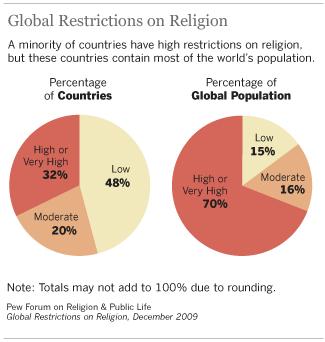
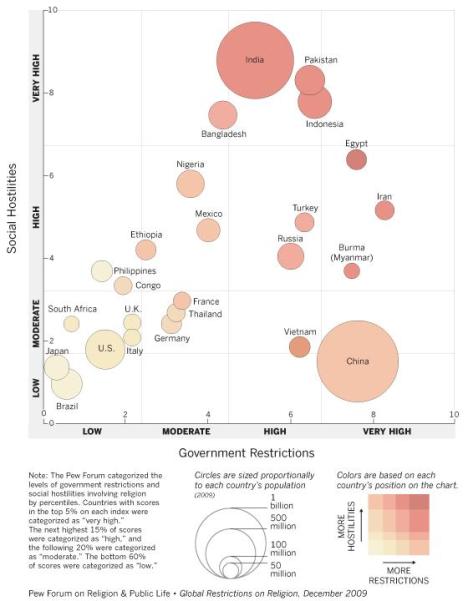
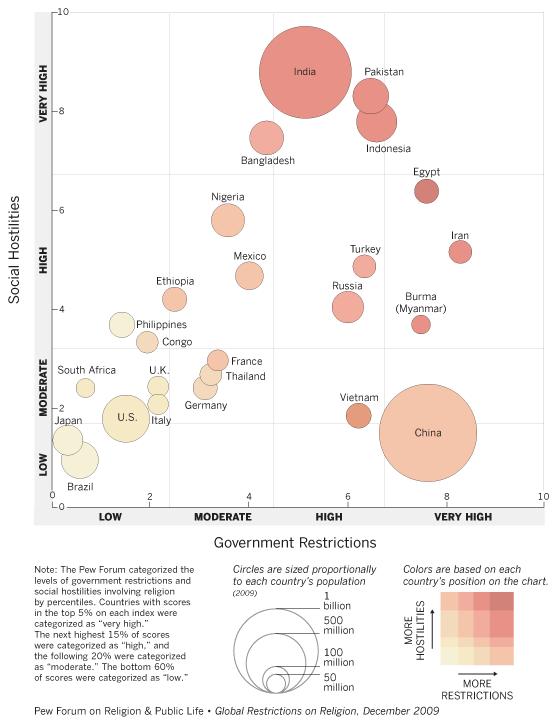
You can link to the full study here.  A summary of the findings can be found in the charts below:


Christianity Today makes these observations:

The Global Restrictions On Religion report finds that only about one-third of the world’s countries impose high restrictions on religion, but these 64 nations contain 70 percent of the world’s 6.8 billion people (thanks to India and China). While almost half of the world’s countries impose low restrictions on religion, this good sign is mitigated by the fact that they only account for 15 percent of world population.

And then later…

Other findings of interest:

  • 75 countries (38%) have governments that limit efforts at evangelism or proselytizing.
  • 178 countries (90%) require registration of religious groups, and in 117 countries (59%) registration requirements result in problems or discrimination against certain faiths.
  • Most countries (87%) have experienced public tensions between religious groups in recent years. Such tensions involved physical violence in 126 countries (64%).
  • Faith-based terrorism killed people in nearly 1 in 10 countries worldwide.

I was surprised to see that the U.S. is not the most religiously “free”, according to this study.  Read the full study and then let me know what you think.

Posted in Human Rights, Politics | Tagged , , , , , , , , , , , , , | 2 Comments

Enjoy your nativity, even if it is wrong…

‘Tis the season for Christmas decorations and what Christian home would be complete without a nativity scene featuring our new-born Savior?

Of course, we can just overlook the historical inaccuracies.  For instance, while it is true that Jesus was wrapped up and lying in a manger when the shepherds went to see him (Luke 2:16), it is not true that he was still in the manger when the wise men showed up.  By this time, Jesus had been moved into the house (Matthew 2:11).  Some scholars speculate that Jesus may have been as much as two years old when the wise men visited.  This is based upon Herod’s command to kill all male children under two years of age (Matthew 2:16).

Speaking of wise men, your nativity features three.  The Bible does not tell us how many there were.  It simply tells us that they presented three kinds of gifts to Jesus: gold, frankincense, and myrrh.  There could have been two men.  There could have been far more than two or three.  We just do not know.

Also, concerning those wise men, the Bible never calls them “kings” as they are often depicted.  You may have heard the song “We Three Kings”, but in Scripture, they are simply “magi”.  The word means they were astrologers, not kings.

Your nativity probably abounds with different animals standing, sitting, and lying around.  The Bible does not mention any animals being present.  I guess since the birth takes place in a stable with a manger, it is assumed that there were animals present, but this is not necessarily the case.

A last, very important thing to note about our nativities is the baby Jesus.  Yours is probably very white.  Jesus was an Israelite.  He was Jewish.  He was not an American caucasian.  His skin color was likely dark.

I hope you enjoy your Christmas holiday and your nativity.  Does anyone have one that is more accurate than the one I described?

Oh, if your nativity features a little drummer boy all I can say is, “Really?”

Posted in Christmas | Tagged , , , , , , , , | 10 Comments

Feel free to mix your religions. It’s the American way.

An interesting article appeared in Reuters today.  It shows some eye-opening statistics concerning American religious belief.  Have a read and then let me know what you think.

DALLAS (Reuters Life!) – Although most Americans are Christian and many are devout it hasn’t stopped some members of the flock from believing in astrology, reincarnation or the ability of trees to trap spiritual energy.

A poll by the Pew Forum on Religion & Public Life shows a surprising number of U.S. adults claim to have had supernatural experiences such as ghost sightings or hold beliefs associated with the New Age movement or Eastern religions.

And some of them claim allegiance to more traditional faiths such as Catholicism or evangelical Protestantism.

“American religious folks hold a variety of views and there is overlap among their beliefs and practices. Many do not fit into simple boxes,” said Pew researcher Alan Cooperman.

The poll released on Wednesday showed that three-in-ten Americans say they have felt in touch with a dead person and 18 percent say they have seen or been in the presence of a ghost.

Other Pew surveys have shown that relatively few Americans would identify an Eastern religion or New Age spirituality as their core faith. But about a quarter of those surveyed say they believe in aspects of Eastern religions.

Nearly 25 percent said they believed in reincarnation and 23 percent said yoga was a spiritual practice. Twenty six percent said they believed “spiritual energy” could be found in objects such as trees.

A quarter said they believed in astrology, while 16 percent of U.S. adults think that an “evil eye” exists or that some people can cast curses or spells on others. Among black Protestants the evil eye figure is 32 percent.

The number of Americans who profess a belief in astrology is about the same as the number who claim to be Roman Catholic. Nearly 30 percent of Catholics surveyed said they believed in astrology. Among Catholics who attended church each week the figure was 16 percent.

Much of this would be jarring to — among others — many evangelical Protestants, who account for one in four adult Americans and take their Bible very seriously.

Still, 13 percent of white evangelicals profess a belief in astrology and about 10 percent accepted the possibility of reincarnation. Although the percentages are lower than in other groups, they are high enough to curl the hair of a Southern Baptist preacher.

Researchers said they were careful to stress that reincarnation meant being reborn again and again in this world and did not refer to, say, the resurrection of Christ.

Evangelicals, who place a heavy emphasis on spiritual conversions, are much more likely than most Americans to have had “a religious or mystical experience — that is, a moment of religious or spiritual awakening,” according to the poll.

About half of Americans claim to have had such an experience but among white evangelicals the number is 70 percent and for black Protestants it is 71 percent.

The nationwide survey of around 4,000 adults was conducted in August. Interviews were done in English and Spanish.

The original link to this article can be found here.

Is there consistency in holding to Christianity while also holding to many of the other beliefs mentioned in this article (e.g. reincarnation, astrology, the “evil eye”, ghosts, etc.)?  What are your thoughts?

Posted in Culture, Worldview | Tagged , , , , , , , , | Comments Off on Feel free to mix your religions. It’s the American way.

2 Corinthians 6:14-7:1 – Can Christians ever partner with unbelievers?

2 Corinthians 6:14-7:1 reads:

Do not be unequally yoked with unbelievers.  For what partnership has righteousness with lawlessness?  Or what fellowship has light with darkness?  What accord has Christ with Belial?  Or what portion does a believer share with an unbeliever?  What agreement has the temple of God with idols?  For we are the temple of the living God; as God said,“I will make my dwelling among them and walk among them, and I will be their God, and they shall be my people.  Therefore go out from their midst, and be separate from them, says the Lord, and touch no unclean thing; then I will welcome you, and I will be a father to you, and you shall be sons and daughters to me, says the Lord Almighty.”

Since we have these promises, beloved, let us cleanse ourselves from every defilement of body and spirit, bringing holiness to completion in the fear of God.

This passage is often referenced in relation to how Christians should approach marriage to an unbeliever.  However, it also referenced by some in relation to how Christians should approach their dealings with unbelievers regardless of the context.  In the minds of some, Christians should never form a partnership of any kind (be “yoked”) with an unbeliever.  If we attempt to apply this understanding of the passage, is it even possible?

When we vote, are we not “partnering” at some level with those we vote for (either the candidate or the party)?  What about when we make a political contribution?  What if we sign a petition protesting a political point (e.g. abortion, gay marriage, etc.)?  Do we need to be sure that the political candidates, parties, and other signatories are all from the same theological belief system as we are?

What about when we take a job?  Does our boss need to be a Christian?  What about all of our co-workers?  If we are athletes, do all of our teammates and coaches have to be Christians to not violate 2 Corinthians 6:14-7:1?

I think you get my point.  It is impossible to apply this passage to every relationship / partnership that a Christian has.  It is not intended to be applied this way.

So then, what is the correct application?  The key to understanding this passage correctly lies in verse 7:1.  It is about maintaining holiness.  Christians are to avoid those relationships that have a potential to hinder their walk with God and influence their moral decisions.  Believers can have parnterships with unbelievers in any area where this type of influence does not exist.

Posted in Bible Study | Tagged , , , , , , , , , , , , | 1 Comment

Have you signed the Manhattan Declaration?

Have you / will you sign the Manhattan Declaration?  If you are not familiar with it, please take the time to read through it.  It is not very long and it is sure to be discussed a great deal in the days ahead.  It will be beneficial to know its contents.

You can find the website for the Manhattan Declaration at www.manhattandeclaration.org .  There, you can download a copy of the declaration, which is seven pages in length.  You can also view a list of well-known signatories.

A brief summary of the declaration is found on the website homepage.  It reads:

Christians, when they have lived up to the highest ideals of their faith, have defended the weak and vulnerable and worked tirelessly to protect and strengthen vital institutions of civil society, beginning with the family.

We are Orthodox, Catholic, and evangelical Christians who have united at this hour to reaffirm fundamental truths about justice and the common good, and to call upon our fellow citizens, believers and non-believers alike, to join us in defending them. These truths are:

  1. the sanctity of human life
  2. the dignity of marriage as the conjugal union of husband and wife
  3. the rights of conscience and religious liberty.

Inasmuch as these truths are foundational to human dignity and the well-being of society, they are inviolable and non-negotiable. Because they are increasingly under assault from powerful forces in our culture, we are compelled today to speak out forcefully in their defense, and to commit ourselves to honoring them fully no matter what pressures are brought upon us and our institutions to abandon or compromise them. We make this commitment not as partisans of any political group but as followers of Jesus Christ, the crucified and risen Lord, who is the Way, the Truth, and the Life.

After reading the long version of the document, let me know what you think.  Will you / did you sign it?  Why or why not?

Posted in Abortion, Human Rights, Marriage / Dating, Politics | Tagged , , , , , , , , , , , , , , | 2 Comments

How will you spend Black Friday?

Black Friday is coming.  It is only a little over two days away (less for those who choose to get in line early enough for the best deals).  If you are wondering, Black Friday is the Friday after Thanksgiving.  It is the official kick-off for the heavy Christmas shopping season.  Why the name “Black Friday”?  Well, it’s the day that stores traditionally have begun to make money for the year.  From Black Friday on, stores are “in the black”, or making a profit.

The day has really become a holiday in and of itself.  I know many who year-after-year go out in the early morning hours in hopes of grabbing a bargain that is too good to be true while others go just to experience the excitement in the air.  I went out for the first time three years ago.  It was the last time for me.  The stores were packed at 7am.  The lines at Best Buy ran the entire perimeter of the store.  No deal was good enough for me to wait that long.

But Black Friday is more than just a special shopping day.  It is a day that seems to truly reflect our attitudes towards the Christmas holiday.  The day that Christians are to remember the birth of their Savior, in reality is nothing more than a material world in blatant self-indulgence.  How did it come to this?  How did our appetite for more become so bad that we now even have a shopping holiday?  How do you spend your Black Fridays?

Posted in Christmas, Consumerism | Tagged , , , , , , , , , , , | 1 Comment

As Americans Go Hungry, Where Is The Church?

The USDA has released a report showing that 49 million Americans are short on food.  17 million of these are children.  That is an increase from 11% of Americans in 2007 to nearly 15% in 2008.

It is great that the government wants to set up programs to help these people.  However, I wonder what responsibility the church bears in this area.  How many churches have ministries to help those in their own community who lack the basic necessities for life?  If my experience is the norm, there are not many.

The Church has the ability to assist the world with their greatest need – their sin, which separates them from God.  However, if we are unwilling to help with basic physical needs, why would non-Christians turn to us at any time?

Has the Church become so specialized that it only deals with the “spiritual” and not the physical?  It seems that ministering to the whole person – both the spiritual and the physical – is the biblical way.  I am not sure we are doing that very well.

What are your thoughts?

Posted in Church Issues, World Hunger | Tagged , , , , , , , , , , , , , | 3 Comments

Do Babies Go to Heaven?

Most people agree that it is a tragedy when a baby dies.  It is a tragedy when anyone dies, but it is especially difficult when the life of a young one ends, regardless of the reason.

There is little comfort that can be given to one who is grieving such a loss, but would it not be helpful to know that the departed child is in the care of a loving and gracious God?  Well, that is the majority view in Christianity.  When a baby dies, the child goes to heaven to be with God.

However, what is the reason for this belief?  After all, the Bible does tell us that all have sinned (Romans 3:23).  This includes babies (Psalm 51:5).  The Bible also tells us that the wages of sin is death (Romans 6:23).  Scripture is clear that all people are sinners from birth and that they deserve death and separation from God.  The only way to avoid death and separation is to place our trust in the sacrificial death of Jesus Christ, which is able to atone for our sins and give us eternal life with God.

A baby is not able to come to such a decision, so if it is true that a baby is “born into sin” as the Bible states, how could it ever be saved?  The most common answer I have heard to this question comes from theologically derived reasoning.  There is no specific passage of Scripture that gives us the answer, but instead we look at things we can learn from the text of the Bible and develop our reasons from there.

It is argued that babies go to heaven because God is just.  He is good.  And he is loving.  Would a just God send a baby to eternal punishment?  Would he do so if he was good and loving as well?  The answer we arrive at is usually “no” to these questions.  There is no justice in sending a baby to hell.  It is not good.  It is not loving.

There is nothing wrong with developing our understanding of God and his character through theological reasoning, but would it not be better if we had a specific verse to give us assurance?  Well, in this case, I believe that there is a passage that we can look at that gives us some insight into this issue.  I am surprised that this passage is not cited more frequently by those discussing the subject of child death.

In 2 Samuel 12:15-23, David’s young son is dying.  We find David in a state of mourning.  He is laying on the ground and not eating.  He is pleading with God to save his son.  Then the child dies.  David’s men are afraid to tell him about the death of his son for fear that David may harm himself.  If he was so distraught while the child was still alive, how is he going to respond when he learns that the child has died?

However, when David is made aware of his son’s death, something odd happens.  David ceases to mourn and returns to his normal routine of life.  The men ask him why he mourned while the child was alive, but stopped when the child died.  David responds:

While the child was still alive, I fasted and wept, for I said, ‘Who knows whether the LORD will be gracious to me, that the child may live?’  But now he is dead.  Why should I fast?  Can I bring him back again?  I shall go to him, but he will not return to me. (1 Samuel 12:22-23, ESV, emphasis mine).

The words of David give us great insight into our topic.  David states in verse 23 that he expects to one day “go to him”.  That is, he expects to one day be reunited with his child.  David was no doubt a man of God.  Scripture presents him in no other way.  So if David expects to be reunited with his deceased child, while also expecting to be with God, we can have the same expectation.

I believe that those who die before reaching an age of understanding go to be with God.  I believe this for theological reasons.  I believe this because Scripture hints at this fact.  Losing a child is a tragedy.  I hope that having assurance of the child’s destiny can give us all some level of comfort.

Posted in Bible Study | Tagged , , , , , , , , , , , , | 1 Comment

Free John Piper Audio Book – DESIRING GOD

Desiring-Godfree You probably know by now that I have a great respect for John Piper.  He is a tremendous teacher and Christian leader.  I fully recommend the resources that he makes available at his website: www.desiringgod.org .

If you are like me, you probably really like books.  Well, christianaudio.com is giving away free downloads of Piper’s popular book Desiring God all month long.  If you have not read it, you should take the time.  Since this is an audio book, you can even sit back and let someone else do the reading for you.  All you have to do is listen!

If you are interested in downloading the free Desiring God audio, click on the image and follow the instructions.  I hope you enjoy!

Posted in Uncategorized | Comments Off on Free John Piper Audio Book – DESIRING GOD